
Raptors of South America
The two-volume book project
By Matías A. Juhant

Book Project Summary
South America harbors one of the greatest diversities of raptor species in the world, an assemblage characterized by wide variation in overall coloration and plumage patterns. This phenotypic diversity reflects the presence of species from multiple evolutionary lineages inhabiting diverse biogeographic regions. Plumage diversity and molt strategies in these species are highly complex compared to other regions. These intricacies strongly influence phenotypic variation and field identification, yet they have not been comprehensively described or synthesized in the scientific literature.
Both volumes of this book project are structured around a conceptual framework consisting of seven concentric rings, which together provide an integrative approach for assessing the diversity of coloration and plumage patterns of raptors across the South American continent. These rings progress from inner to outer levels of complexity, forming a stepwise system that is essential for understanding intraspecific variation, taxonomic interpretation, and the assignment of English common names. This structure ultimately allows for the development of the most complete and standardized species accounts to date.
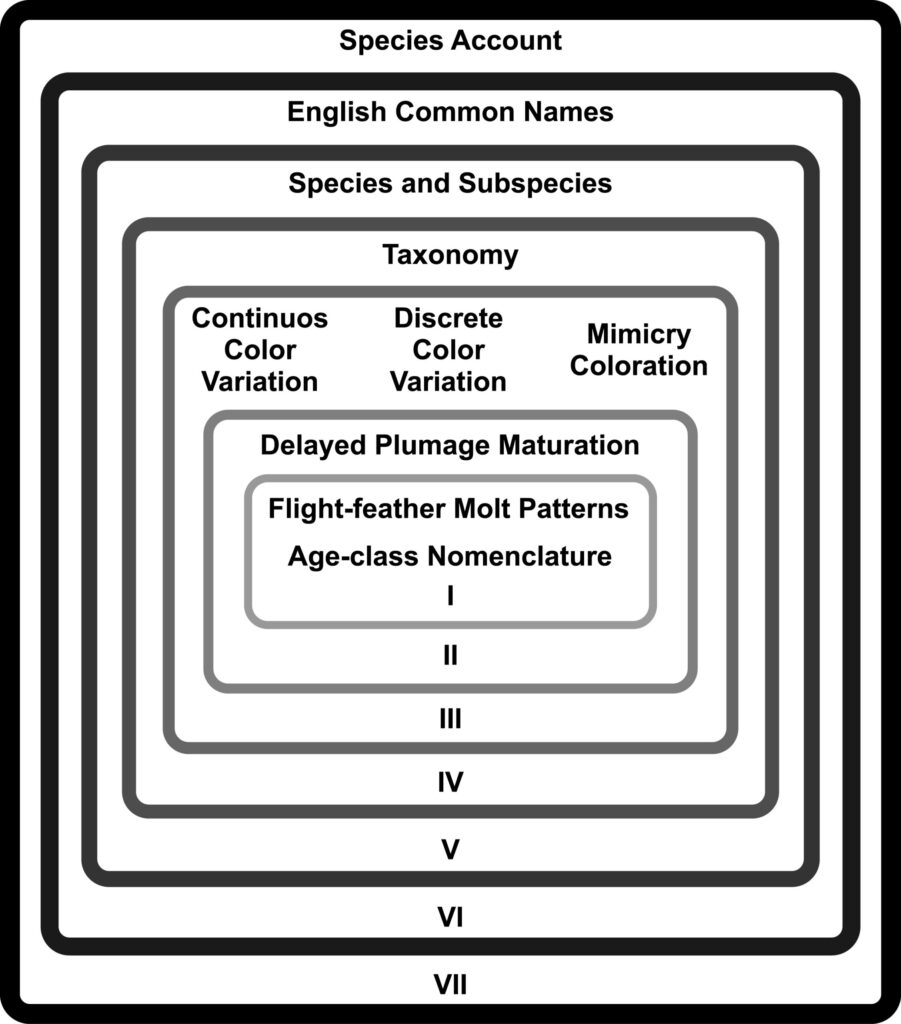
Ring I (Flight-feather Molt Patterns and Age-class Nomenclature). Raptors of the orders Cathartiformes, Accipitriformes, and Falconiformes exhibit different molt strategies in their flight feathers, particularly the primaries. Because a full discussion of the strategies of these three orders, as well as the variation within each, would be extensive, I will provide an example from Black-chested Buzzard-Eagle, a species belonging to the order Accipitriformes that undergoes four annual molt cycles to acquire the Definitive Basic (adult) Plumage or Basic V.
In Accipitriformes, primaries are replaced once a year in sequence during the molting season, beginning with the innermost feather (P1) and progressing outward to the outermost feather (P10).

In the Black-chested Buzzard-Eagle, primaries undergo a partial molt, known as serial or stepwise molt, in which each annual molt cycle initiates a new wave of primary replacement at P1. This results in the simultaneous presence of feathers from different molt cycles.

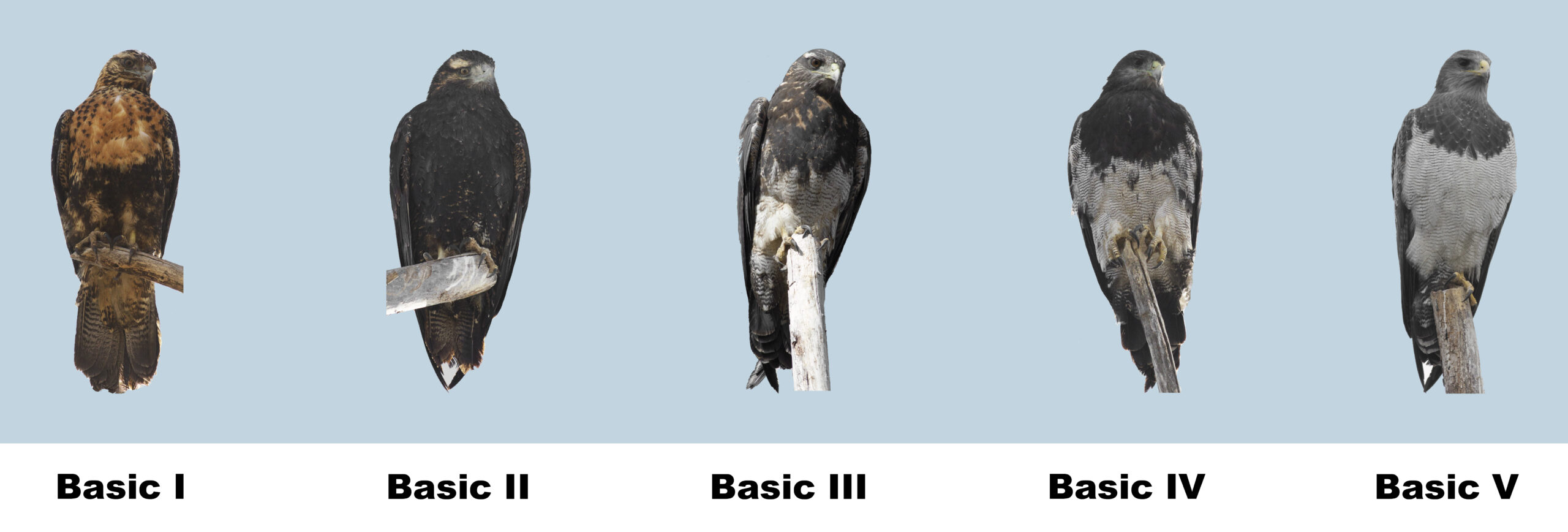
Age-class nomenclature is grounded in the annual molt cycle, with each class defined by a distinct pattern of primary molt progression. Basic I plumage (juvenile) shows a single generation of primary feathers (i.e., all feathers are of the same generation). Basic II plumage (second year) shows two generations of primaries (i.e., P1–8 Basic II feathers and P8–10 Basic I feathers). Basic III plumage (third year) shows three generations (i.e., P1–3 and P8–9 Basic III feathers, P4–7 Basic II feathers, and P10 Basic I feathers). Basic IV plumage (fourth year) shows two generations (i.e., P1–2, P4–7, and P10 Basic IV feathers, and P3 and P8–9 Basic III feathers). Basic V plumage (adult) has replaced all primaries more than once, making it no longer possible to accurately age individuals based on their flight feather molt.
Ring II (Delayed Plumage Maturation). Several endemic and near-endemic Neotropical raptor species exhibit delayed plumage maturation, during which individuals undergo multiple annual molt cycles before acquiring their Definitive Basic Plumage. Black-chested Buzzard-Eagle is an example of a species exhibiting delayed plumage maturation, and the plumage sequence is based on annual molt cycles of the flight feathers (primaries, secondaries, and rectrices).
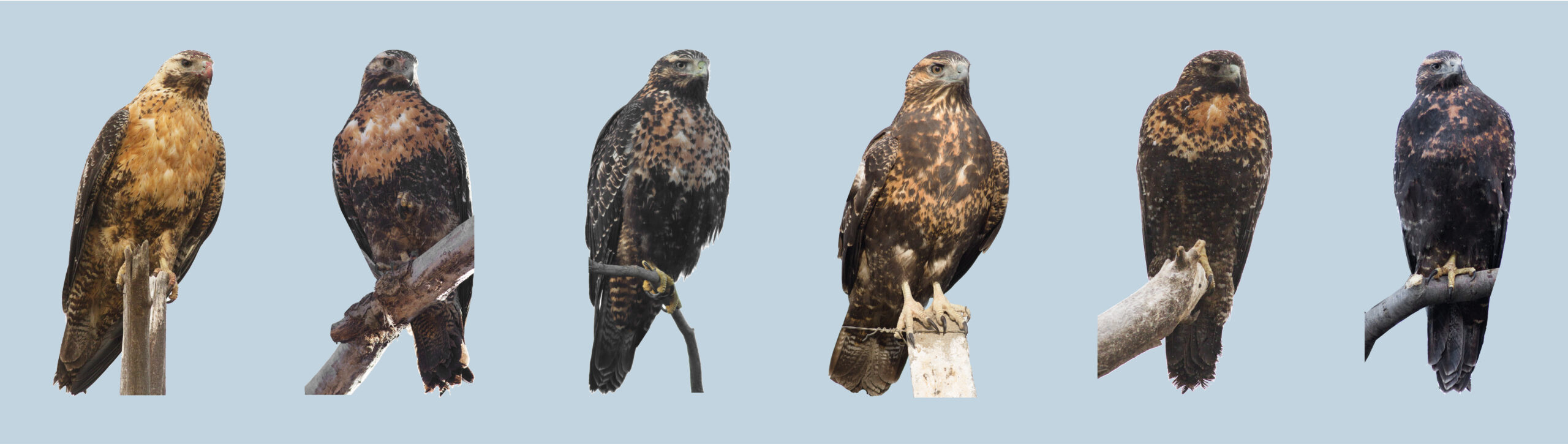
Ring III (Coloration). Due to the diversity of species inhabiting different biogeographical regions, and the fact that several species are widely distributed across the continent, natural selection pressures vary among regions. As a result, coloration within species and across age classes shows considerable variability. Three main types of color variation are observed: (1) Continuous color variation, as illustrated by the Black-chested Buzzard-Eagle within the same age class, as shown below for individuals in Basic I plumage; (2) Discrete color variation, in which species exhibit distinct plumage types in the Definitive Basic Plumage, are often under strong genetic control—these plumage types are defined as morph-types, and their frequencies vary within populations; finally, (3) Mimicry coloration occurs in some species, particularly in Neotropical rainforests, where species such as the Gray-billed Hawk and Gray-headed Kite mimic the Definitive Basic Plumage of the Ornate Hawk-Eagle during their Basic I plumage, however, this plumage is transient and does not persist into their Definitive Basic Plumage.
Ring IV (Taxonomy). By systematically documenting and understanding the phenotypic variation of each species, we can gain a clearer picture of the characteristic traits that define each subfamily within each order. This framework provides a robust foundation for linking phenotypic traits to formal taxonomic groupings, facilitating comparative analyses across the South American raptor assemblage.
Ring V (Species and Subspecies). By comprehending Rings I–IV, we can gain a clear understanding of phenotypic variation at the species level. If a species exhibits a discrete distribution range, the differentiation of populations based on phenotypic traits can serve as complementary information, together with genetic data, to define subspecies. And if a species exhibits a continuous distribution range can serve as complementary information to assess the clinal variation.
Ring VI (English Common Names). By considering the phylogenetic position of each species, together with an understanding of their phenotypic traits, appropriate English common names can be assigned. For example, the name Black-chested Buzzard-Eagle is misleading, as this species belongs to the subfamily Buteoninae and forms a monophyletic group together with the Variable Hawk and White-tailed Hawk. Therefore, the term “Buzzard-Eagle” should be replaced with “Hawk,” and “Black-chested” should be replaced with “Dark-chested,” reflecting the species’ chest coloration. Basic V exhibits a gray chest, while considerable variation occurs in previous age classes; as a result, the species would be more appropriately referred to as the Dark-chested Hawk.
Ring VII (Species Account). The integration of Rings I–VI will help produce the most advanced and comprehensive species accounts for each South American raptor. Each species account will include text describing variation across age-classes, morph types (when applicable), and the sequence of plumages from Basic I plumage to the Definitive Basic Plumage, illustrated with high-quality photographs. The species accounts are based on a meticulously organized photo bank designed to capture the full assemblage of South American raptors.